
Changing Traditions
Some folk customs from the past included practices that would not be acceptable today. One example is blackface, where people darkened their faces with soot or paint. This was sometimes part of dances, parades and games.
Historians and folklorists have suggested different reasons for the practice. Some historical accounts say that people darkened their faces as a disguise, so they would not be recognised while dancing or collecting money. However, some descriptions also use racist language, and the practice was similar to minstrel entertainment that caricatured and mocked Black people.
Today, we understand these aspects of the past differently. Blackface has become rare in traditional celebrations, as communities continue to adapt old customs to reflect the values of the present.
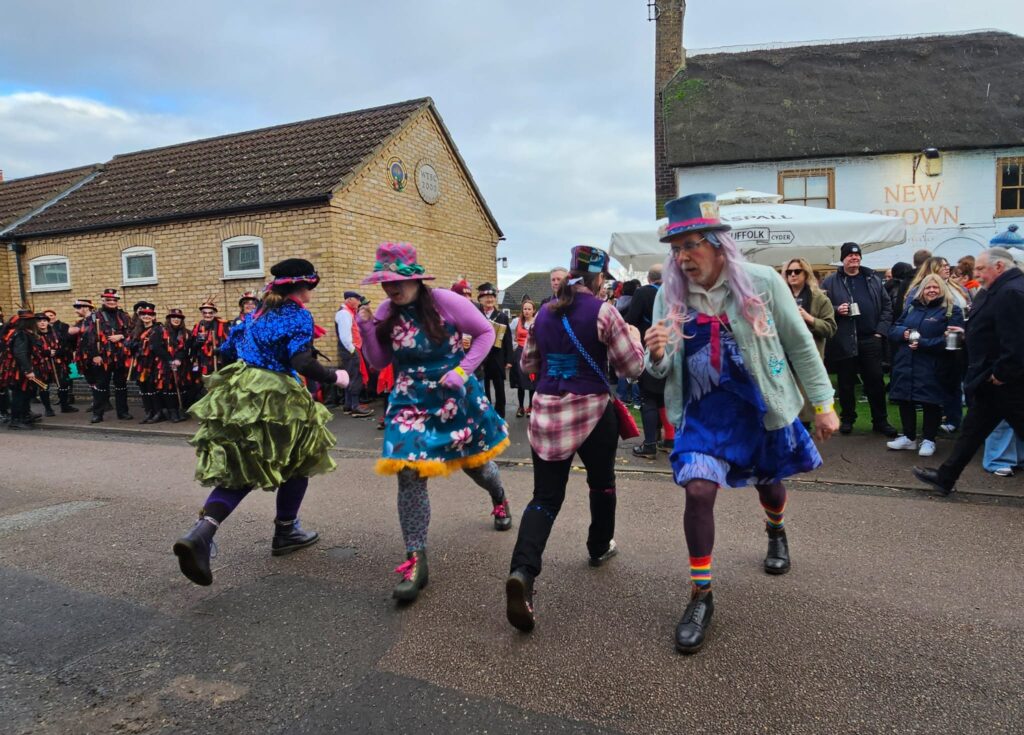
Traditional music and dance remain part of Cambridgeshire’s cultural life. Molly and Morris dancers, folk musicians and step-dancers continue to perform, teach and pass these traditions on to new generations.
Collecting stories
The following audio clips were collected for this exhibition and demonstrate storytelling, modern folklore, and oral histories from Cambridgeshire.
1. The Knight and the Bees, Read by Gemma Oakley, Adapted from a version by Enid Porter, Cambridgeshire Customs & Folklore, p192-194. Courtesy of East Anglian Folklore Centre, @east_anglian_folklore_centre
The East Anglian Folklore Centre is a physical (and digital) space that offers an invitation, where folk who are interested in how we storytell our landscape; through Art, Craft, Tale, Song, Dance, Ritual, Tradition and Practice…might gather.
2. A ghostly tale recounted by Charlie Ashton interviewed by Kevin Delanoy in 1978. Courtesy of the Lorna Delanoy Archive via. Capturing Cambridge.
During the Seventies many fenland people were interviewed, particularly those who had connections with farming, for the Haddenham Museum Sound Archives. In 1978 Charlie Ashton, a Romany Gipsy who travelled through Cambridgeshire, was interviewed by Kevin Delanoy. Here we hear about a ghost story he encountered on his travels.
3. Fen farmer Bob Giddings interviewed for Anglia TV in 2007. Courtesy of Capturing Cambridge.
In 2007, Anglia TV’s Bygones programme revisited the Farmland Museum (now Denny Abbey & The Farmland Museum) at Haddenham, Cambridgeshire, as it had done in 1975. Reminiscing about life on a Fen farm, former farmer Bob Giddings reflects on the highs and lows of country life, using local parlance such as ‘docky’ (breakfast or lunch) and ‘shocking’ corn (bundling corn stalks together to dry for storage).
4. Rouf – the folk dance from Jammu and Kashmir in India, Narration and script by Krishna Zivraj-Nair, 2020. Courtesy of Sanskruti Dance Cambridge via Capturing Cambridge.
An area’s folklore and folk practices evolve with its population. As people come and go, customs are shared, learned and adapted. This is one of the reasons folklore is continually evolving. Traditions such as the Kashmiri folk dance Rouf (danced in Cambridge by the Sanskruti Dance group) demonstrate how cultural practices originating elsewhere are enjoyed in Cambridgeshire today. This is not a new feature of folklore; migration has long been fundamental to its development, as can be seen throughout the centuries.
5. Fen Skating by Chip Colquhoun
Listen closely as storyteller and author Chip Colquhoun introduces us to the local custom of fen skating and tells the tale of a fen skater who overcame sabotage to beat a steam train! You can find real fen skates in the Fen and Folklore room. If you haven’t seen them already, why not take a closer look?
6. The Countryman’s Favour by Alex Horn
Discover the tradition of making tokens from woven corn, and find out how these handcrafted gifts could play a part in courtship!
7. Enid Porter on collecting local folklore
From a film by the former Cambridge & County Folk Museum Craft Group, produced as part of the Fenland Stories Project, 2005.
During her time as curator at the Museum of Cambridge, Enid Porter made it her life’s work to collect and document the folklore of East Anglia, helping to preserve local stories, customs and traditions for future generations.
8. A Cherry Hinton ghost and a Haunted Boarding House by Weronika Trynkiewicz, Cambridge resident
Discover tales of ghostly encounters at work and at home, right in the heart of Cambridge. Have you ever seen or felt the presence of someone from beyond this world?
See more: