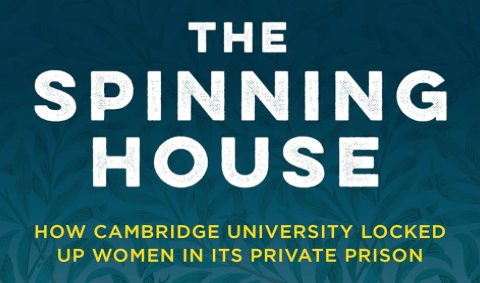
Last June the Cambridgeshire Association for Local History (CALH) recognised the work of outstanding local researchers by awarding its annual awards during a well attended meeting at the St John’s Community centre on Hills Road. Amongst the winners was former trustee of the Museum, Caroline Biggs, whose book, The Spinning House: How Cambridge University Locked up Women in its Private Prison (History Press, 2024), offers a breathtaking account of the brutal imprisonment of innocent young women in nineteenth century Cambridge. The University, operating under ancient laws that gave the institution the power to arrest and jail women in its own prison, the Spinning House (on St Andrew’s Street), ruined the lives of many until the community stood up against the cruel treatment its daughters were subjected to.
This is a story of misogyny and institutional abuse that shows what happens when large corporate bodies are allowed to prosecute outside common law. The University, so far, has remained very reluctant to comment on events that can be traced as far back as the reign of Elizabeth I, when it was first granted a charter (26 April 1561) sanctioning the “incarceration of any woman suspected of corrupting the morals of the young undergraduates at Cambridge University” (Spinning House p. 15).
Caroline’s book is a major contribution not only to local history but also to the more general history of women in England as it highlights the extreme challenges women faced in society: going for a walk around Cambridge in the evening with friends could lead women to be labelled as prostitutes and to be seized and imprisoned.
Other notable winners of the CALH awards include a beautiful photo book by Andrew Swift, 125 Village Churches of the Historic County of Cambridgeshire (Velox Books, 2024), two books on the Misericords and Choir Stalls of Ely Cathedral (available in Ely Cathedral bookshop), and a report on the Hicks Houses (Hicks Houses Report) available on Capturing Cambridge, the Museum’s social history website. The photos of the Misericords of Ely Cathedral are stunning and the carvings shown are a remarkable testimony of Fenland culture in the 12th and 13th century. The Challis Museum in Sawston also received an award for its outstanding community work – a little museum worth visiting.
The awards highlighted the talent of local authors, their research skills, their love of local history and most of all their love of Cambridge and Cambridgeshire; something to celebrate. The Museum of Cambridge congratulates all the winners for their dedication to local history. There would be no museum without historians.