By Dr N. Henry
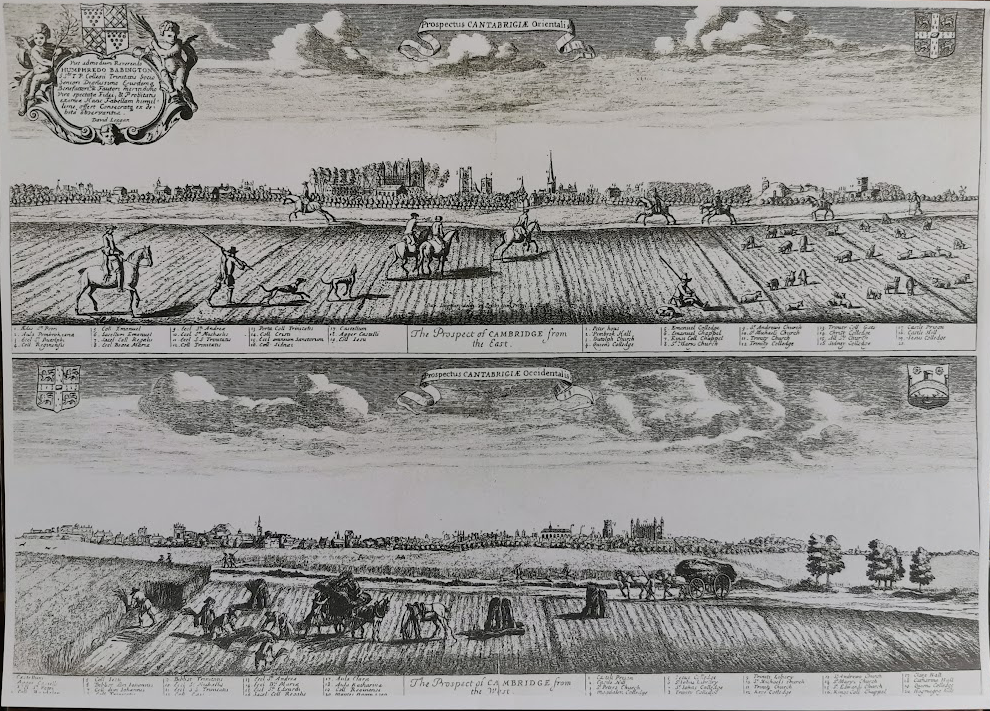
The Museum of Cambridge has on display, on the first floor, an antique print of David Loggan’s views of Cambridge from the east and the west. This print was once part of Cantabrigia Illustrata, a book of plates describing the University of Cambridge and published in 1690 by David Logan at his own expense after twelve years of observing, sketching and engraving.
Not much is known about David Loggan but it is likely that he was born in Poland around 1635 and possibly learned engraving in Denmark before coming to England sometimes before 1653. By 1665, he was living in Oxford where he produced Oxania Illustrata in 1675, a book of plates describing Oxford University. A year later he was employed in Cambridge to print Wren’s design for the library of Trinity College. As he was provided with a printing press, it is no surprise that he then decided to produce plates to illustrate the buildings of Cambridge University just as he had done for Oxford. The work took twelve years as he aimed to “submit everything to the closest examination of the mind, as well as of the eye”. These are Logan’s own words in his introduction to Cantabrigia Illustrata, where he also explains his method: everything was down on paper, engraved on copper and then printed “skilfully”.
He aimed for precision, especially when it came to the architectural details of the colleges and the panoramic views of the town. Logan’s views of Cambridge from the east and the west show all the town’s main buildings aligned in the correct order with the spires of the town churches mingling with the chapel roofs of colleges and their impressive entrances. The overall impression of these panoramic views is one of the harmony brought on by religious piety.
In his dedication of the book to William and Mary, King and Queen of England, Logan is keen to underline that Cambridge is full of “splendid monuments of ancestral piety”. He adds that his dedication to them is especially fitting as the King and Queen have “overthrown the enemies of the church”, meaning the Catholics. Religion in the seventeenth century was an important factor of social cohesion as well as the cause of divisions. It also occupied an important part in the curriculum at University with the three main subject studies being Theology, Law and Medicine. Such a narrow curriculum was criticised by Francis Bacon and Milton who both had enjoyed a Cambridge education.
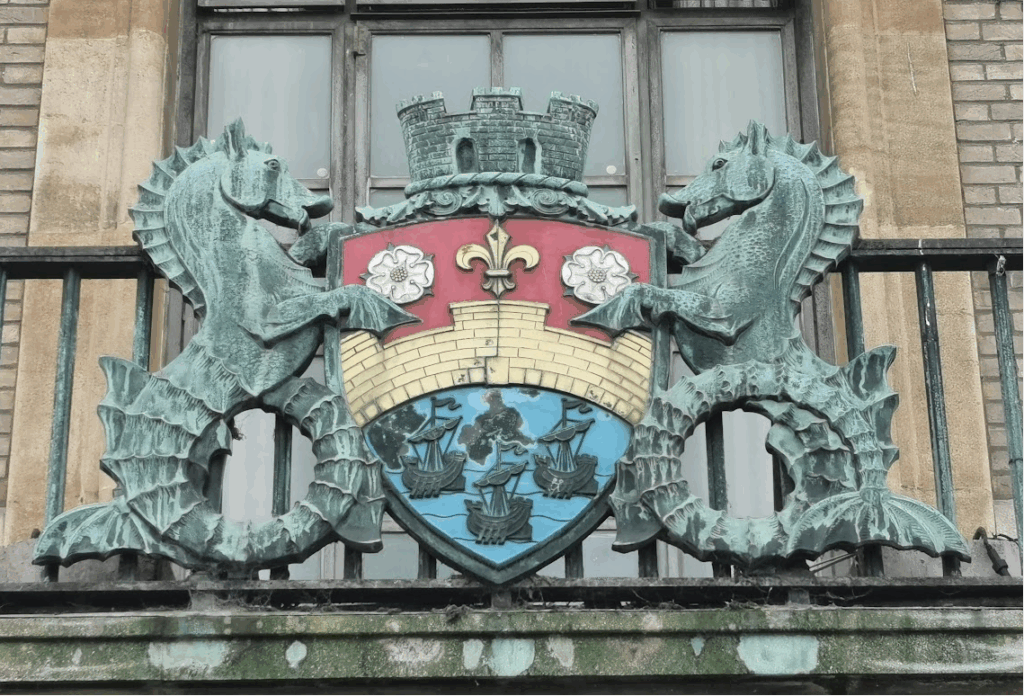
Loggan’s print also shows together on the same page both the arms of the University (top right) and of the town (lower right) strengthening the feeling of harmony and interdependence. The arms of the town show the castle, the bridge and the river with lighters (small boats). This looks very similar to the Cambridge City shield that can be seen today above the door of the Guildhall.
The most interesting part of Logan’s views of Cambridge remains probably the very foreground. Both the prospect from the East and the prospect from the West show fields divided into strips by balks (a thin ridge left unploughed between parcels). The division of common or private land into strips was a very standard practice around Cambridge before the nineteenth century. A mid fourteenth century manuscript kept in Cambridge Library under the name of Terrarium Cantabrigiae has preserved for us the names of owners and occupiers of strips of land around Cambridge, this survey having been completed to record the important tithings. Loggan’s views of the fields are an extraordinary visual record of the early agricultural system in place around Cambridge before the works of enclosure. Furthermore the view from the east shows all the activity that was allowed on land once the harvest had been completed. There is a hunting party crossing the field and a shepherd and his dog watching a herd feeding on the remains of cut corn. Such activities were permitted only once the harvest had been completed. An ordinance from the Corporation of Cambridge in 1583 states that:
It shall not be lawful to any person or persons to feed or pasture any horse mare or gelding, or other beasts upon any balk or balks in the common field of the town, or to reap any balk until the corn of either side of such balk be carried away or set in shock… (Hall and Ravensdale pp. 23-24)
Herds grazing on leftover corn meant that nothing was wasted and this was a practical way to relieve the pressure on grassland.
In Loggan’s view from the west, the harvest is still ongoing and there is no other activity than the gathering of corn, this activity taking priority over any other use of the field.
Loggan’s humble looking print hanging in the Museum of Cambridge on the first floor in the very first room does deserve a place of honour in the history of Cambridge as it is an exceptional testimony on life and work in the seventeenth century. Loggan’s obsession with details left us with an invaluable visual record probably worth much more than the fifty pounds he was awarded by the University for his work of twelve years.
Bibliography:
Loggan, David, Cantagrigia Illustrata, first published in 1690, reprint by J. W. Clark, Cambridge, 1905
Hall C P and Ravensdale J R, The West Fields of Cambridge, Cambridge, 1976
Tames, R, A Short History of Cambridge, Haus Publishing, 2025