
Written by Jess McClenan, Disability Heritage Research Volunteer
This research piece was made possible by a two-year initiative made possible by a £99,802 grant from the Esmée Fairbairn Collections Fund through the Museums Association. This ground-breaking project will place disabled individuals at the forefront of researching, curating, and sharing the histories of disabled people in Cambridgeshire.
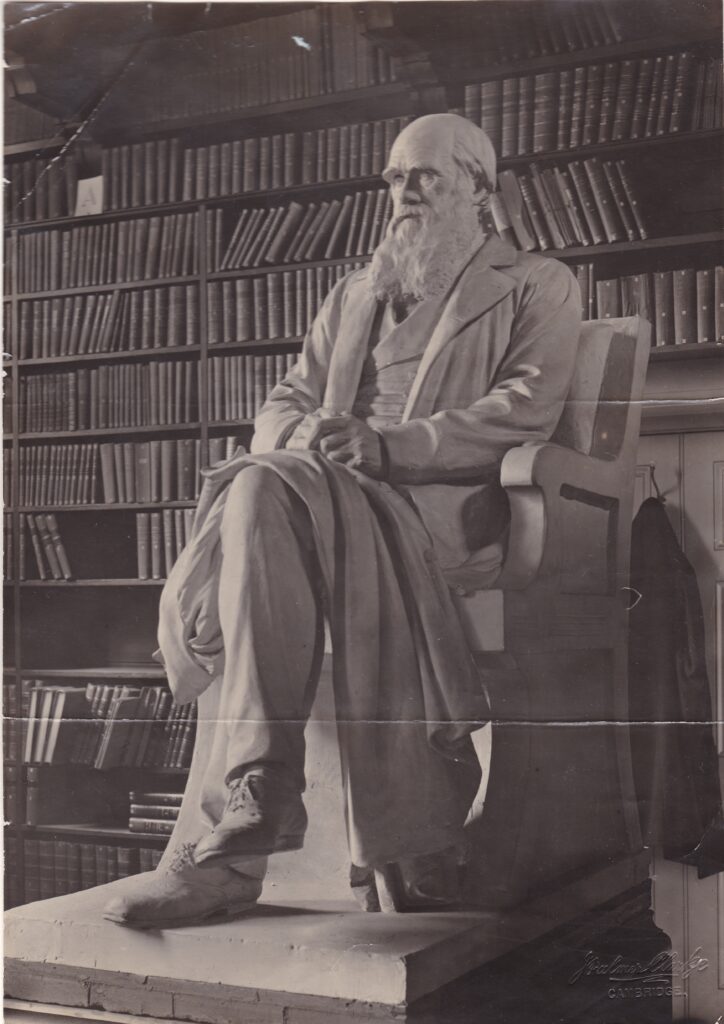
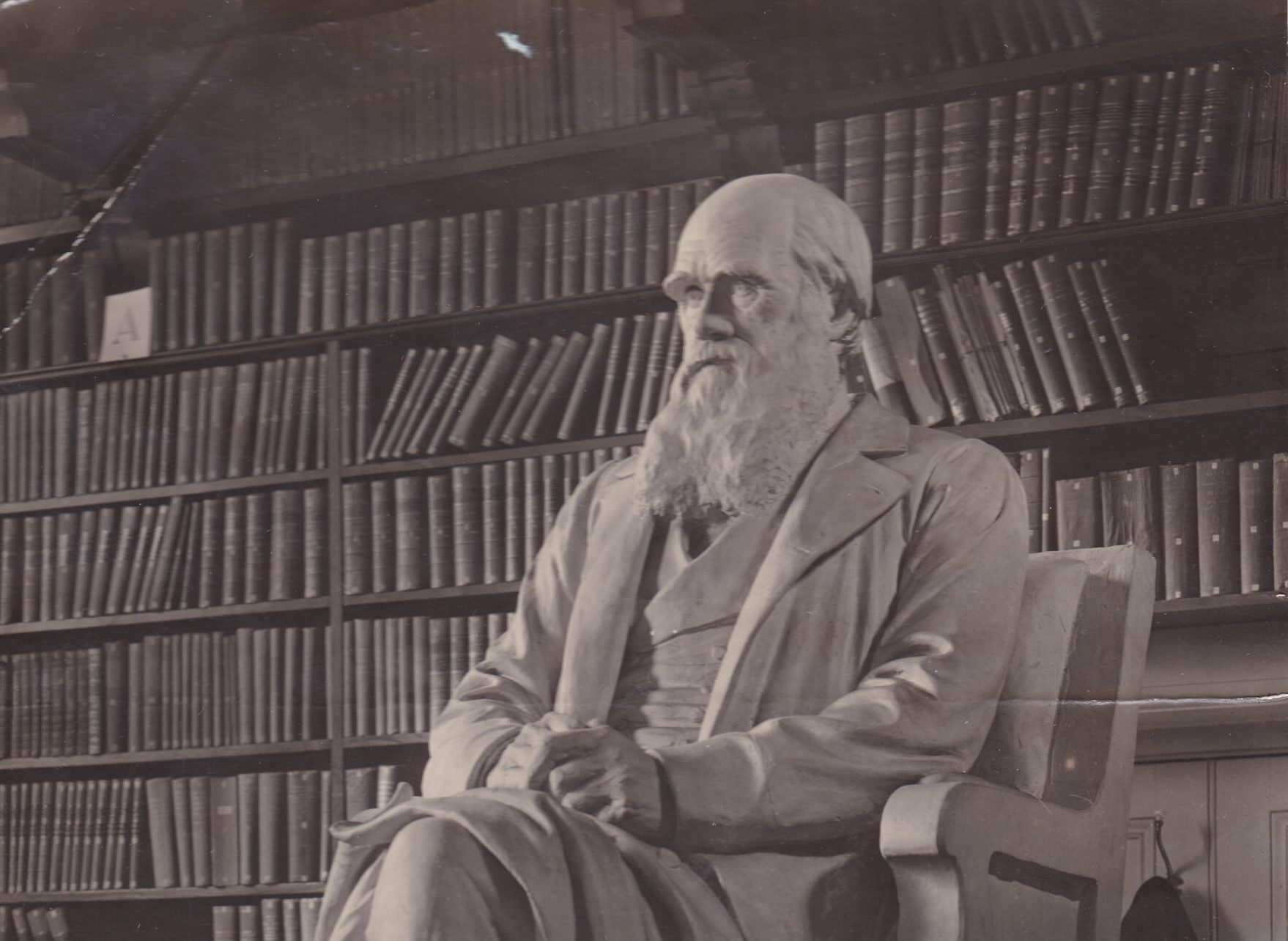
The plaster cast statue of Charles Darwin housed in the lecture room of the University of Cambridge’s Department of Physiology is a fascinating object that brings together art, science, memory, and personal history. It is not only a representation of Britain’s most famous naturalist but also a tangible link between Darwin, his education at Cambridge, and the wider commemoration of his life’s work.
The statue is a plaster cast of Joseph Edgar Boehm’s full-size model of Darwin, first created in 1883. Boehm (1834–1890) was one of the leading sculptors of Victorian Britain, known for his portrait statues and royal commissions. His marble statue of Darwin was unveiled in 1885 in the Natural History Museum, South Kensington, on the grand staircase at the north end of the great hall. This commission was organized by the Darwin Memorial Fund, a body established by Darwin’s friends after his death in 1882 to provide “a visible record of his personal aspect and a memorial of the esteem of his contemporaries.” (University of Cambridge, 2022)
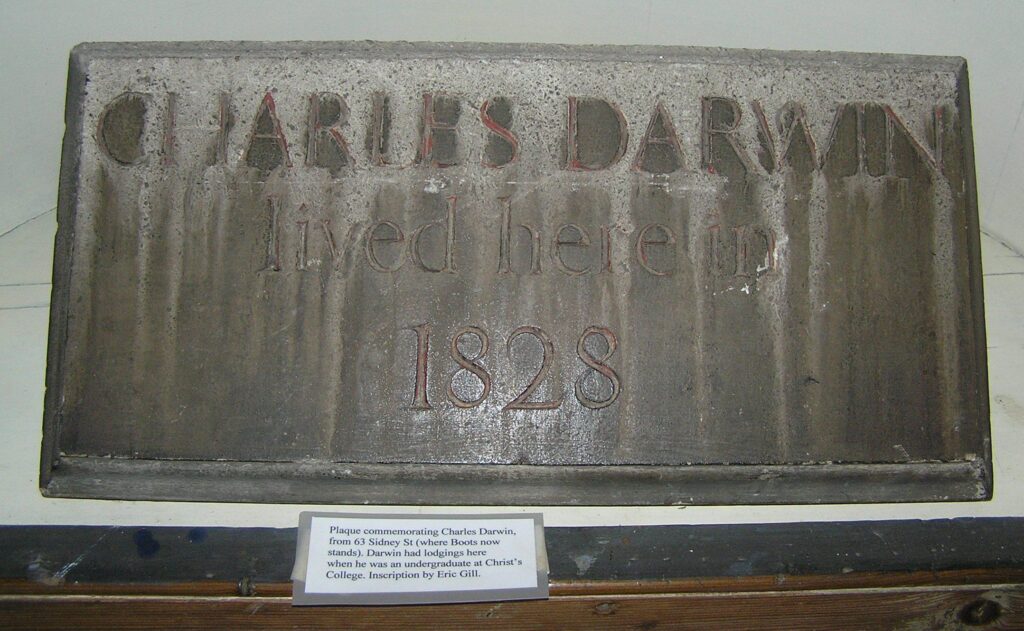
The marble statue immediately became an icon of Darwin’s legacy, symbolizing both Britain’s intellectual achievements and the centrality of evolutionary thought in late Victorian science. To broaden access to the work, plaster casts were made from Boehm’s model. In 1891, members of the Darwin family presented one such cast to the University of Cambridge. The gift was especially fitting: Darwin had studied at Christ’s College, Cambridge, between 1828 and 1831, where he prepared for a career in the church but found his true passion in natural history. Cambridge was where Darwin honed his observational skills, joined field trips with leading botanists and geologists, and began laying the groundwork for the scientific curiosity that would shape his career. (van Wyhe, 2022)
The cast was placed in the lecture room of Comparative Anatomy, the part of the University curriculum most directly tied to Darwin’s scientific contributions. Comparative anatomy and physiology were central to Darwin’s arguments for evolution, and the lecture room was an important teaching space for zoology and related subjects. Cambridge had no natural history museum of its own at that time, so situating the statue in a teaching department closely aligned with Darwin’s work made the most sense. By the early twentieth century, the room had become part of the Department of Physiology, and the statue remained there, quietly presiding over generations of students.
The statue also carries a connection to disability heritage. Darwin’s later life was shaped by chronic illness. From the late 1830s he suffered from recurring bouts of abdominal pain, nausea, vomiting, palpitations, tremors, and profound fatigue. His condition worsened over decades, compounded by emotional strain such as the death of his daughter Annie in 1851. Doctors prescribed harsh remedies, including mercury and hydrochloric acid, but Darwin often sought relief in water cures and other treatments. More than forty different diagnoses have been proposed for his illness, ranging from psychosomatic explanations to infectious diseases. Recent research suggests that Darwin’s symptoms align with what is now recognized as cyclic vomiting syndrome, possibly linked to a mitochondrial disorder (Hayman, 2009; Finsterer and Hayman, 2014). These struggles highlight how Darwin worked under significant physical limitations, a reminder of the ways disability and ill health shaped his daily life and scientific productivity.
Seen through this lens, the plaster cast statue is more than a likeness. It is a monument to resilience and creativity in the face of adversity, a commemoration of Darwin as both a student and a scientist, and a marker of how Cambridge sought to honour one of its most famous alumni. Today, the story of the statue enriches our understanding not just of Darwin himself, but also of how institutions remember, commemorate, and contextualize figures who have left a lasting mark on science and society.
References
Finsterer, J. and Hayman, J. (2014). Mitochondrial disorder caused Charles Darwin’s cyclic vomiting syndrome. International Journal of General Medicine, p.59. doi:https://doi.org/10.2147/ijgm.s54846.
Hayman, J.A. (2009). Darwin’s illness revisited. BMJ, [online] (339), p.b4968. doi:https://doi.org/10.1136/bmj.b4968.
University of Cambridge (2022). 2.13 Edgar Boehm, statue in the NHM. [online] Darwin Correspondence Project. Available at: https://www.darwinproject.ac.uk/about-darwin/portraits-charles-darwin-catalogue/213-edgar boehm-statue-nhm [Accessed 29 Sep. 2025].
van Wyhe, J. (2022). Darwin and Christ’s College | Christs College Cambridge. [online] Cam.ac.uk. Available at: https://www.christs.cam.ac.uk/about/history/darwin-and-christs-college.
The Museum of Cambridge is the independent social history museum of the City and County of Cambridgeshire. As a registered charity the Museum relies on your support to enable volunteering opportunities such as this.
For more information on how to support the Museum of Cambridge’s vital work to preserve local history for future generations, visit www.museumofcambridge.org.uk or phone 01223 355159.