
Content warning: This article contains historical accounts of domestic violence, homicide, prostitution and sexual exploitation, including child sexual exploitation.
Written by Roger Lilley, Museum of Cambridge Trustee
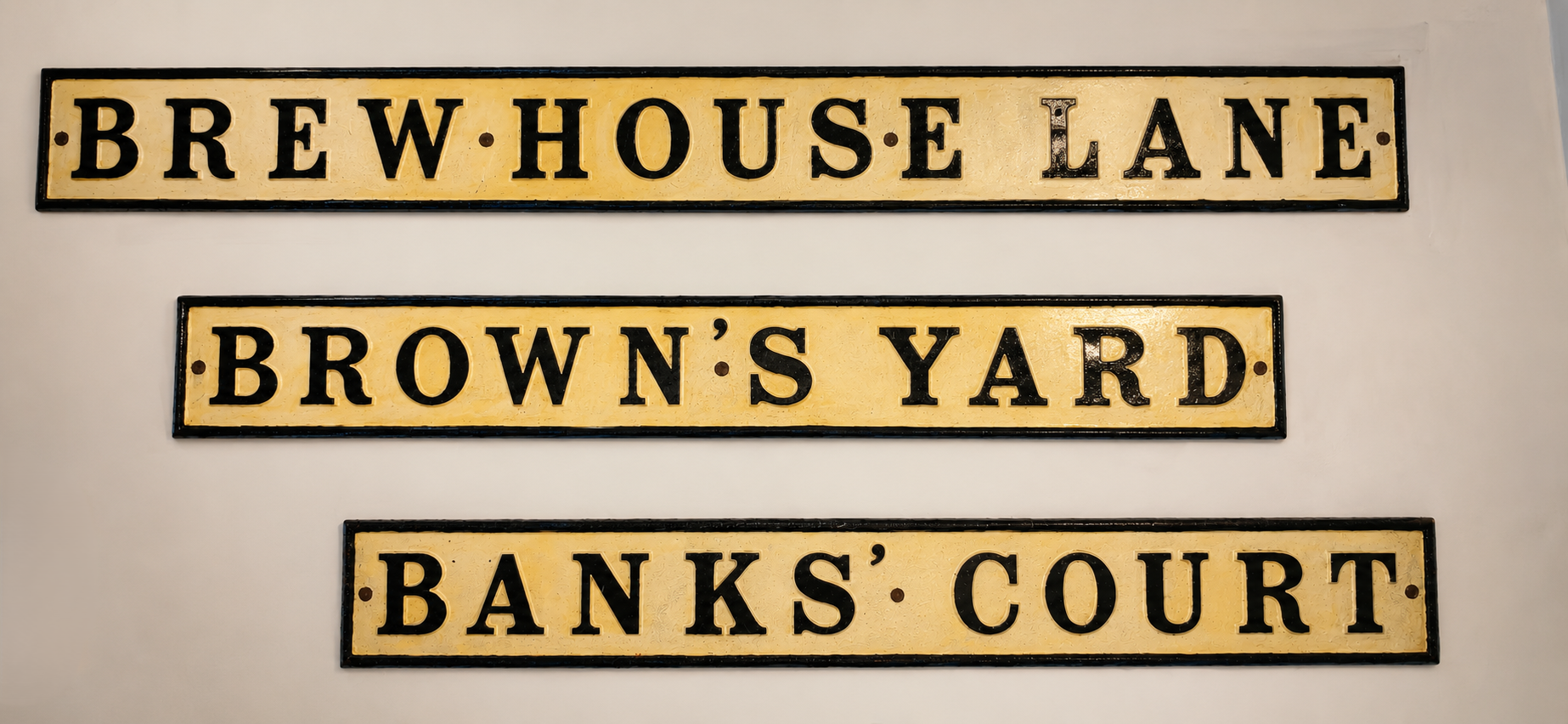
The Museum of Cambridge exhibits a number of old enamel street signs: Falcon Yard, Ram Yard and Honey Hill. But perhaps the most obscure is Brown’s Yard. Where was this?

A reader of the Cambridge Independent Press in the 19th century would have had no doubts as to the location of this notorious slum. Situated just along from the site of the new Travelodge, there is absolutely nothing left of the 19th century streetscape today.
Brown’s Yard was a tightly packed collection of around eight dwellings inhabited by labourers, laundresses, widows, hawkers and sex workers. A very vivid impression of the atmosphere is gained from the press report of 1848:
Many of the courts in that locality, such as Brown’s yard and Swann’s yard, were in the most filthy state, dangerous to public health; with large open cesspools and accumulations of filth of every description while the inhabitants were huddled in small, close apartments, and hence the places were never free from fever and small pox, which thus spread over the town and neighbourhood.
The great and good of Cambridge are here discussing who is responsible and who should pay for the clean up. The Nuisances and Removal and Diseases Prevention Act of 1848 had just been passed. Designed to prevent future outbreaks of cholera, local authorities now have powers to enforce clean ups.
Such squalid lodgings only drew the most desperate tenants, often those whose livelihoods depended on rubbing shoulders with criminality. The Cambridge Independent Press of 21st July 1849 offer a lengthy account of domestic violence between a couple from Brown’s Yard: [WO]MAN KILLED BY HER PARAMOUR. BRUTALITY AND DEMORALIZATION. Ann Simms had died at the hand of George Shaw who is described in these terms at the inquest:
Shaw gains a precarious livelihood by attending fairs and feasts; keeps at times a paltry gambling table, for children to risk and lose their halfpence; at other times he attends races to sell cards on the course, and on all which occasions the unfortunate deceased accompanied him, to gain money by infamous practices, for his use.
The events of the case revolve around the Melbourn feast and the witnesses are those who are traipsing back along the road to Cambridge in the early hours of the morning. Numerous people are interviewed both at the inquest and the resulting trial. George Shaw is convicted of manslaughter and sentenced to transportation for life, though there is no evidence that he actually reached Australia.
In 1850 the commissioners are still trying to sort out the cesspools in Brown’s Yard. One problem is locating the owner. There is a Mr Brown, but he is only the rent collector, except that no-one ever has any money to pay him.
Readers of the Cambridge Independent Press would have continued to read stories about residents of Brown’s Yard assaulting each other with fists and bottles, threatening each other with knives. There is riotous behaviour and bad language; the Cambridge Independent Press (1.6.1894) describes the state of affairs in Brown’s Yard as a “civil war”.
The fearful and disgusting conditions of life which these and other enquiries disclosed attracted the particular attention of more than one member of the Bench, and therein perhaps lies the origin of the fact that this week a raid has been made upon this hotbed of disorder and crime. Rarely, if ever, has the Police Court been the scene of enquiry so revolting in its character as that which took place on Tuesday, and which disclosed to the public eye a phase of life in Cambridge the most horrible and the degraded is possible to imagine.
The target of the police is Mary Ann Paxton, of number 2 Brown’s Yard, who is charged with “being the occupier of certain premises did unlawfully and knowingly permit the said premises to be used a place for the carrying on of habitual prostitution.” The magistrates then have the task of trying to piece together who does what in Brown’s Yard, who is an owner, who a tenant, while a very noisy and excited gallery of spectators look on.
The sad stories from Brown’s Yard are still coming forward in 1910. Emma Williams. 19, a laundress at no.3, was charged with using obscene language. She was living with a four month old baby, in the house of another couple. The Chief Constable is reported as saying, “they all slept together on the floor like pigs.”
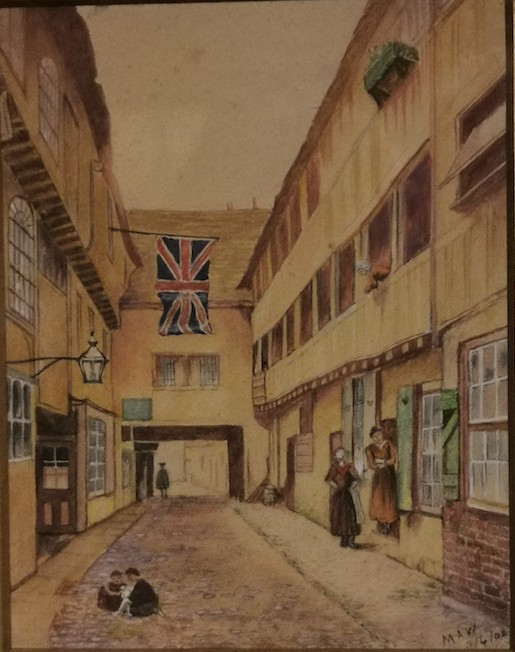
Brown’s Yard disappeared at some point in the mid 20th century. Like many of the ‘yards’ off main streets, it was swept away in the attempt to remove unhygienic slums. Interestingly, at the same time, artists such as Mary Greene were painting these locations and we have numerous watercolours in the museum on display. But its hard not to feel that these scenes represent a rather sanitised view of extreme poverty.
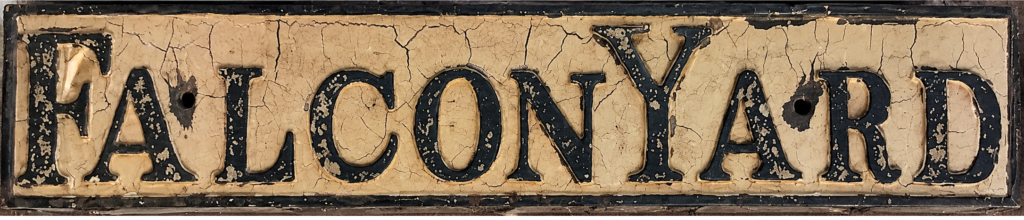
A famous example, and another location whose street sign we have, is Falcon Yard. The old photographs and the painting by Margaret Wadsworth show us a quaint streetscape. But if you read the description in the Morning Chronicle 27.9.1850 you are presented with a very different viewpoint.
But perhaps the worst of all is a place called Falcon yard. In one of the houses which I visited there were thirteen families residing. In a room on one of the floors lived a man, his wife, and five children. The eldest boy was sixteen years of age, the eldest girl, a little over fourteen, having been for several months a common prostitute, and three younger children, together with the parents, all slept in one and the same room
Certainly, the streetscape in Cambridge changed fast during the late 19th and early 20th century. The paintings show us the buildings that disappeared, but much remains to be explored about the lives of those who inhabited them.
For full transcriptions, pictures and census details see:
https://capturingcambridge.org/museum-of-cambridge/museum-exhibit-stories/164-newmarket-road
https://capturingcambridge.org/centre/petty-cury/falcon-yard
See more of the lost streets and yards of Cambridge, captured by local artists in our new exhibition Portraits of Cambridge: a Town in Transition, open until 5th October 2026.
At the heart of the exhibition are artists who captured these changes as they happened, their work forming a rich portrait of a changing town, inviting us to rediscover Cambridge through the places it has lost.
The Museum of Cambridge is the independent social history museum of the City and County of Cambridgeshire. As a registered charity the Museum relies on your support to enable volunteering opportunities such as this.
For more information on how to support the Museum of Cambridge’s vital work to preserve local history for future generations, visit www.museumofcambridge.org.uk or phone 01223 355159.