Written by Hannah Twinberrow, Disability Heritage Research Volunteer
This research piece was made possible by a two-year initiative made possible by a £99,802 grant from the Esmée Fairbairn Collections Fund through the Museums Association. This ground-breaking project will place disabled individuals at the forefront of researching, curating, and sharing the histories of disabled people in Cambridgeshire.
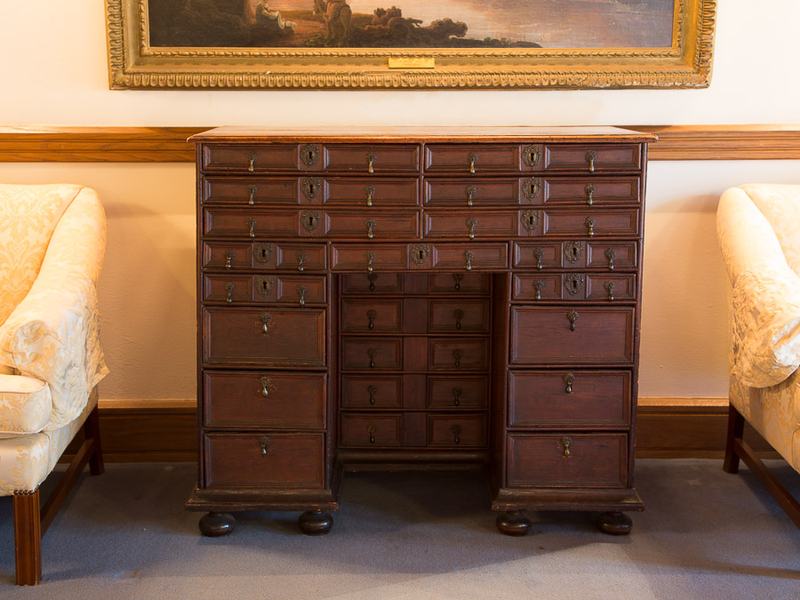
Whether your home contains a green box with a big white cross squirreled away in a bathroom cabinet, or a repurposed tin of quality street filled with paracetamol and plasters, you likely have a medical cabinet in some form, somewhere in your house. The modern-day medical cabinet evolved from the old apothecary cupboard in the 18th and 19th century. Cambridge locals may be familiar with Dr John Addenbrooke’s (1680-1719) medical cabinet (fig.1) housed at St Catharine’s college. This famous physician, and founder of Addenbrooke’s hospital, was a fellow at St Catharine’s college and his 27 drawer medical cabinet takes pride of place in the college to this day. Medical cabinets, such as that displayed in St. Cat’s were commonplace in the homes of medical professionals up until the early 20th century as many doctors and pharmacists worked from their own premises.
But by the turn of the 20th century, alongside the luxurious walnut of professional medical cabinets, one could expect to find slightly less extravagant assortments of personal medical treatments in domestic settings as many families compiled their own medical kit. Collections of preventative and restorative medicines, tinctures, salves and ointments like those in Box 64a (fig.2) at the Museum of Cambridge were compiled for everyday use by families keen to avoid expensive doctors’ fees.
Hopefully, in 2026, you rarely need to dust off your first aid kit and get it down from behind the cornflakes on top of the fridge. But what about 100 years ago? Would your first aid kit and/or medical cabinet have made more of an appearance in your everyday life? And why?
In the late 19th Century/early 20th Century, General Practitioners performed a much broader range of procedures than we would expect nowadays. Doctors handled the usual minor injuries and illnesses, prescribed routine medication, lanced boils and syringed ears, but GPs also delivered babies and even performed surgery.[i] For example, in 1948, GP Harry Pearson Taylor amputated a boy’s arm after it had been crushed by a threshing machine on the Shetland Isles.[ii] An excellent use of his skills – but alas these services weren’t free.
Many GPs offered variable rates dependent on their clients’ income. In 1917, the Ladies Diary and Housekeeper published a table of recommended GP charges that was based upon the rental value of homes, with prices ranging from 2s 6d to 10s 6d (2 shillings and 6 pence to 10 shillings and 6 pence) per visit, but ultimately prices were at the doctor’s discretion.[iii] If you were ill or injured they really had you over a barrel (or should that be: stuck in a threshing machine?).
Until the NHS was established in the United Kingdom on 5th July 1948, GPs operated as private traders.[iv] At this point, everyone became eligible for free primary care, but until then, individuals either paid GPs directly or through insurance schemes such as those run by Friendly societies and sick clubs. Individuals would pay into the sick club pot each week and then if/when they became sick, they could access the society’s doctor for treatment. They could also potentially receive additional financial assistance for some health-related costs if necessary. [v] These schemes were voluntary and often didn’t cover families or female workers.
However, they formed the basis for liberal reforms. In 1911, David Lloyd George introduced the National Insurance Act. [vi] The National Insurance Act enforced a compulsory scheme for industrial workers aged 17-60 which required contributions be made by workers, employers and the government. In return, the scheme provided free medical care and sickness benefits to workers. At the time, there was push back from some businesses and GPs who believed their bottom line would suffer. (Fig.3) However, these concerns were grossly overestimated, and the country instead saw positive health and productivity outcomes. Due to its success, by 1920 the scheme had been extended to cover all workers who earned up to £250 per year (except farm workers and domestic servants).
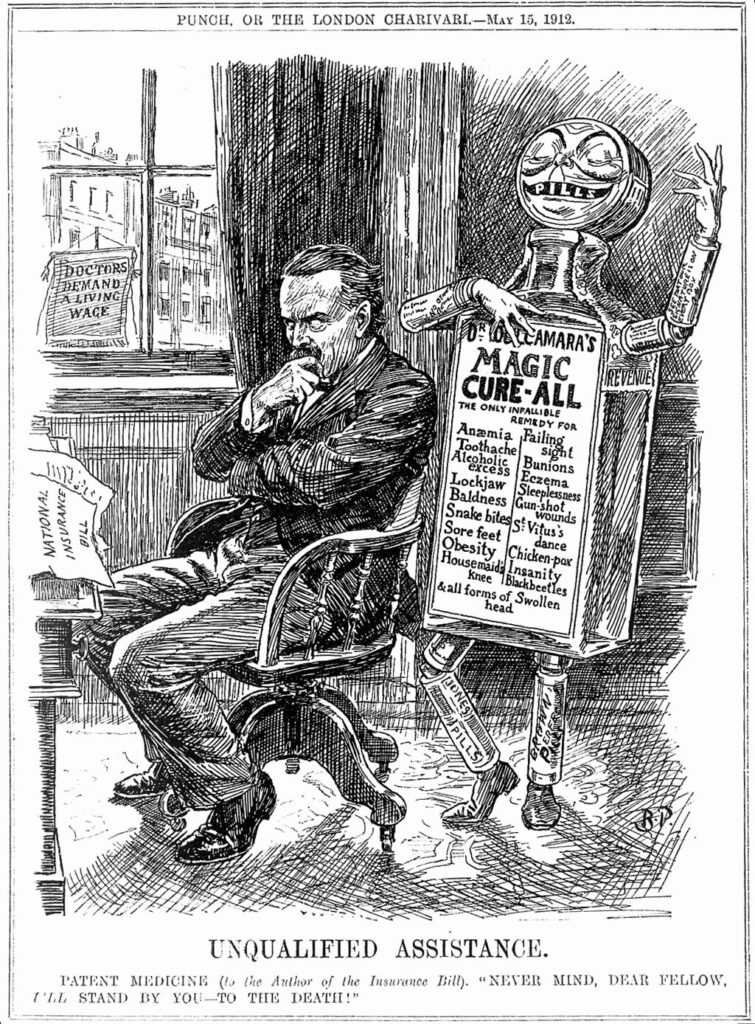
Unfortunately, working women and the families of male workers were not eligible for this scheme (neither the original nor amended version). Therefore, most households continued to stock an essential at-home medical cabinet with a variety of preventative and restorative treatments (such as the items found in Box 64a) to reduce the financial burden of seeking primary care assistance.
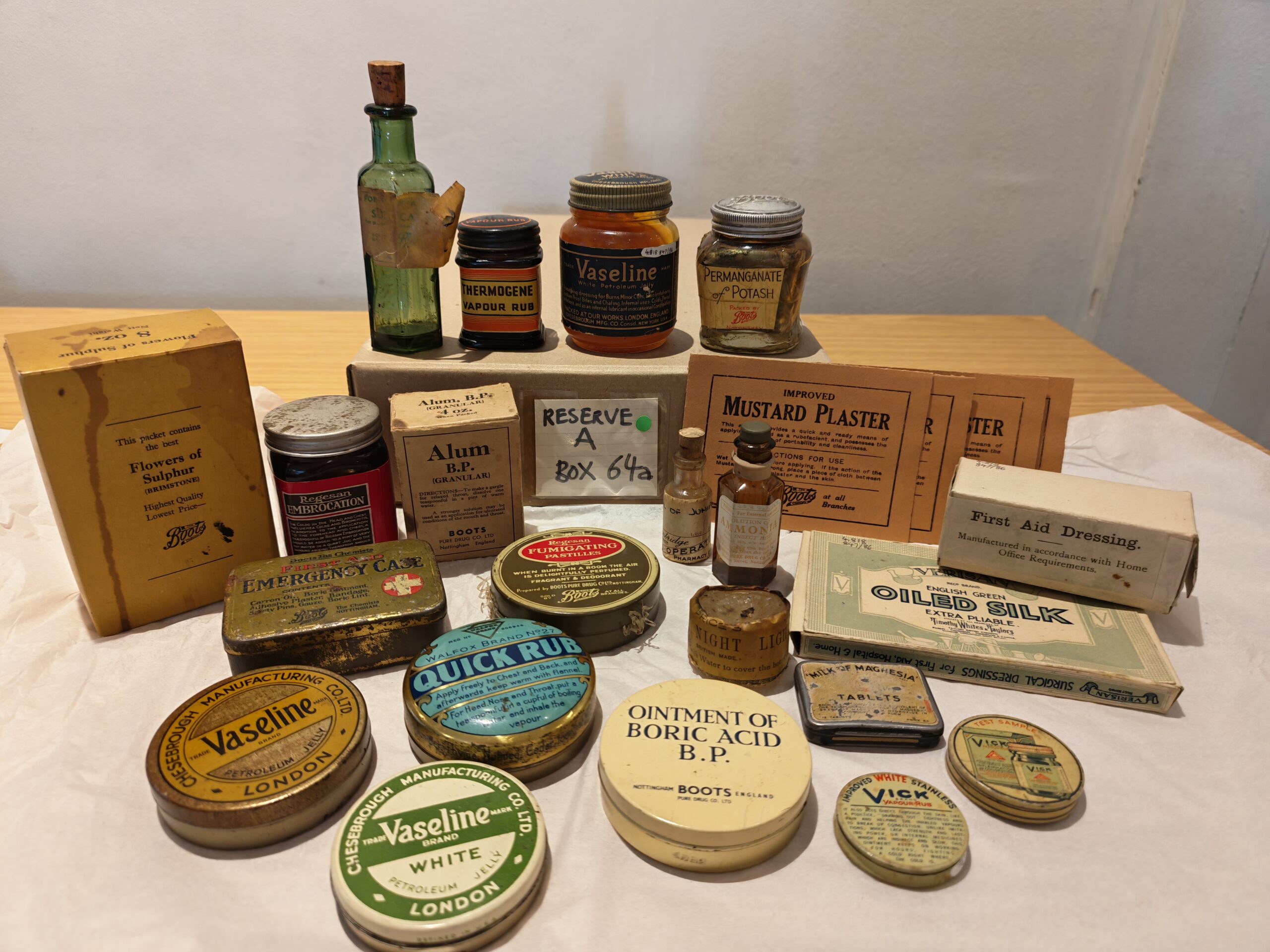
Exhibit box 64a (fig.2) shows a collection of various items found in everyday household medical cabinets from the early 20th century. The collection consists of:
(a) Four pieces of mustard plaster;
(b) A Vaseline ‘Blue Seal’ jar;
(c) A Vaseline white tin;
(d) A Vaseline yellow tin;
(e) Ointment of boric acid from Boots;
(f) Surgical spirit in a green bottle;
(g) Regesan embrocation;
(h) Permanganate of potash;
(i) A small flat milk of magnesia tin with tablets;
(j) Fumigating pastilles for burning by Regesan;
(k) Thermogene vapour rub;
(l) Boots First Aid emergency case containing a finger dressing, a Mentholatom tin, a safety pin, needles and thread, a metal container with glass bottle, white stick;
(m) A Price’s child’s candle nightlight;
(n) A tin of Walfox quick rub;
(o) A box of Alum BP granular;
(p) A Vick test sample tin;
(q) ‘Improved’ white stainless Vic vapour rub;
(r) A wound dressing;
(s) A Wheatsheaf candle nightlight;
(t) A box of Flowers of sulphur (brimstone);
(u) Verisan oiled silk surgical dressing.
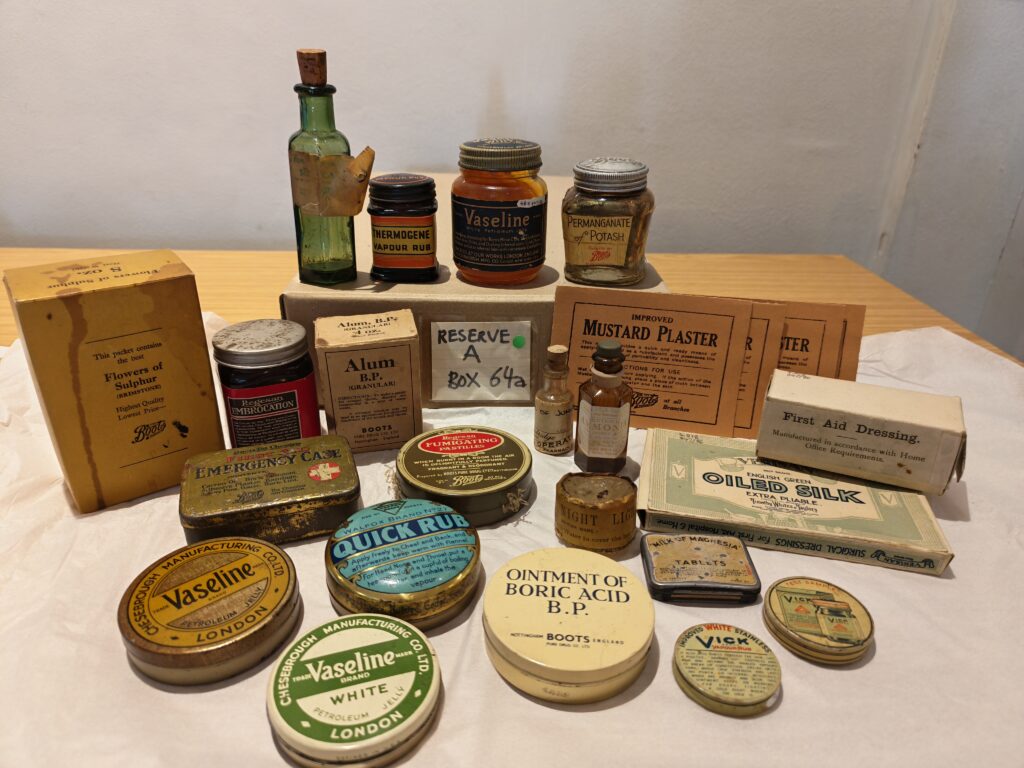
Exhibit Box 64a was donated to the Museum of Cambridge in 1986 by J.H. Sebon of Girton. Comparing the packaging and labels of the various products, it seems that the collection was most likely curated by an enthusiast after 1936 (potentially Sebon themselves) rather than all the items originating from the medicine cabinet of one family. The packaging for ‘The English Green Oiled Silk’ in Box 64a (fig.4) shows that it was produced by ‘Timothy White and Taylors’. Although the ‘Taylor Drug Store’ was originally launched by William Barker Mason (using his wife’s maiden name) in 1881, on Thornton’s Arcade, in Leeds, the chain of pharmacies first operated under the name ‘Timothy White and Taylors’ from 1936 when ‘Timothy White’ (a pharmacy chain in the South) merged with the Northern based ‘Taylor’s Drug Store.’ Timothy White and Taylors was eventually bought out by Boots in 1985. So, whilst the assorted objects of Box 64a were likely brought together slightly later in the century, all the items would have been everyday objects found in homes up and down the country in the early 1900s.
Many of the items in box 64a were purchased from Boots the chemist and whilst it is possible (and indeed probable) that the collector of these objects acquired these bottles, packets, and boxes from various locations (such as car boot sales, auctions, and second hand shops) it’s nice to imagine similar products at home on the shelves of Boots just down the road from the Museum of Cambridge where the contents of Box 64a now live.
John Boot opened the Cambridge branch of Boots at 23-24 Market Hill in 1895 (Fig 4) – 41 years before the Museum of Cambridge opened its doors.[vii] Boot was devoutly religious and sought to create a space where the poor could help maintain their own health. So, in 1949, he established ‘Boots’ in his hometown of Nottingham. It was an herbalist store built on the premise of Thomsonianism where Boot offered affordable alternatives to traditional medicine.
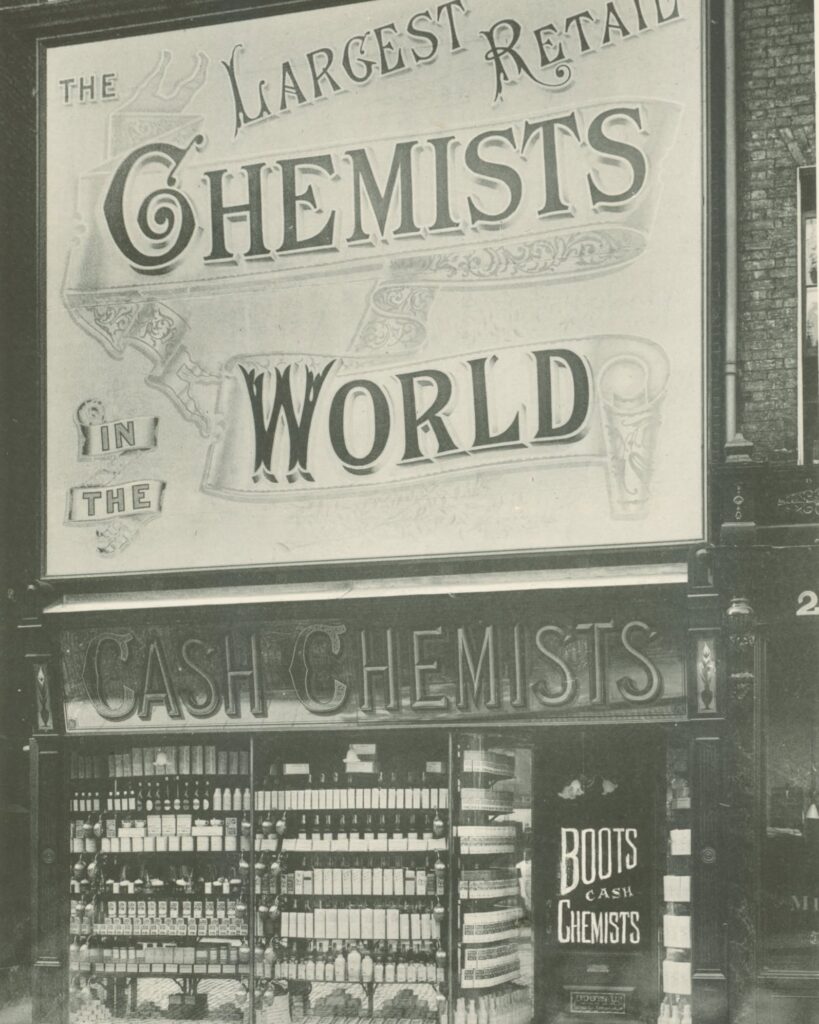
Thomsonianism was a North American-based alternative medicine movement led by Samuel Thomson (1769-1843). Thomson was a self-educated herbalist who believed that disease was a maladjustment in the body’s internal heat and could be remedied with herbs and medicinal plants, vomiting, enemas and steam baths. After Thomson passed away the movement largely fell apart (although it is still endorsed by some science sceptic communities today) as people became more unwell in the absence of professional medical care. However, it inspired Boot to open his flagship herbalist store, providing an affordable alternative to traditional medicine so that even the poorest in the community could help themselves.
After John Boot passed away in 1870, his widow, Mary, and son, Jesse, took over the business, trading as ‘M & J Boot, herbalists’. They primarily sold herbs, roots, plants and flowers which they dried on the parlour’s walls and then powdered. In 1877, Jesse took full control of the business, and the company underwent a shift towards more patented medicine in line with a change in public perception of authoritative medicine. Improving literacy rates meant that large scale advertising campaigns were accessible to more of the working class. Jesse responded by launching the ‘health for a shilling’ campaign which encouraged people to stock up on traditional healthcare products at an affordable price. Products like those seen in exhibit box 64a became staples for households across the country with many remaining so to this day.
Thanks to John Boot’s Thomasonian beliefs, any one of us could have avoided a hefty doctor’s bill by popping into 23-24 Market Hill and can, to this day, seek pharmaceutical assistance for our everyday ills.
Filled with fixes for bunged up noses and banged up knees, the containers may have changed, but the concept remains the same across the ages: medical cabinets and first aid kits cater to our accidents and ailments, providing preventative and restorative treatments for a range of minor illnesses and injuries.
Check out part 2 of this blog to find out more about the uses of the individual items in Box 64a.
[i] The Open University, ‘Medicine Transformed: On Access to Healthcare’, 2026, https://www.open.edu/openlearn/history-the-arts/history-science-technology-medicine/medicine-transformed-on-access-healthcare/
[ii] Taylor, H.P. (1948) A Shetland Parish Doctor, Lerwick: T. & J. Manson, p.76.
[iii] Digby, A. (1999) The Evolution of British General Practice 1850–1948, Oxford: Oxford University Press, pp.100-103.
[iv] NHS, ‘Milestones of the NHS’, 2026, https://www.england.nhs.uk/about/nhs-history/
[v] Mitchell, A. (1991) ‘The function and malfunction of mutual aid societies in nineteenth century France’ in J. Barry and C. Jones (eds) Medicine and Charity before the Welfare State, London: Routledge, p.181.
[vi] BBC Bitesize, ‘Developments in Patient Care: The Beginning of the Welfare State’, 2026, https://www.bbc.co.uk/bitesize/guides/zb3d8hv/revision/4
[vii] Boots, ‘Boots Heritage’, 2026, https://www.boots-uk.com/about-boots-uk/company-information/boots-heritage/
The Museum of Cambridge is the independent social history museum of the City and County of Cambridgeshire. As a registered charity the Museum relies on your support to enable volunteering opportunities such as this.
For more information on how to support the Museum of Cambridge’s vital work to preserve local history for future generations, visit www.museumofcambridge.org.uk or phone 01223 355159.